How it works
Simple model. Proven in six cities. Ready for Lawton.
What you're actually getting
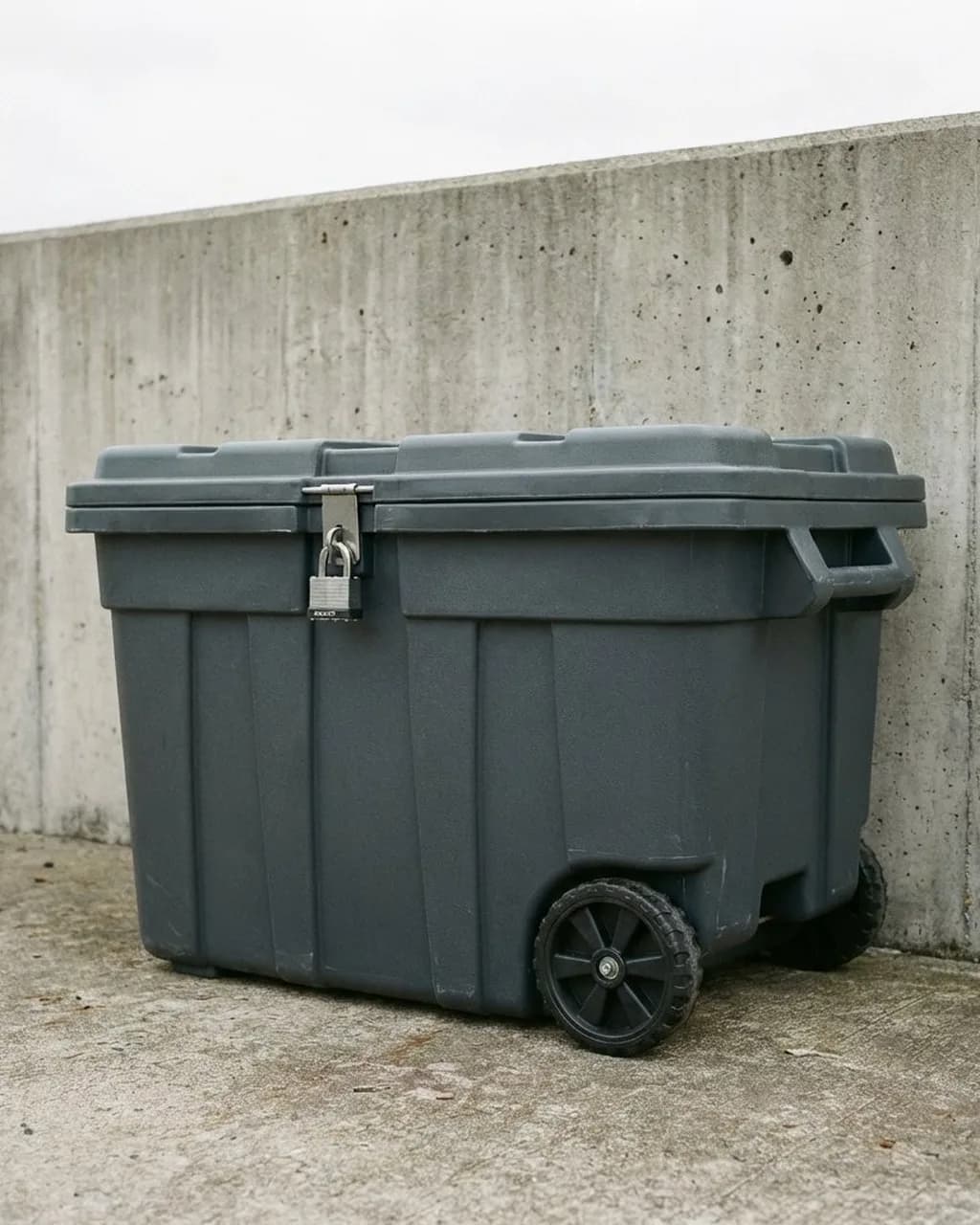
Each participant receives a heavy-duty rolling storage bin — approximately 60-gallon capacity — fitted with integrated locking hardware and a weatherproof ID tag. The bin is stored at a secured partner site. The participant keeps the key.
These are commercial-grade containers rated for outdoor conditions and repeated use. Not a cardboard box. Not a trash bag. Not a gym locker in a building you can't reach. A bin that holds what a person needs to carry — bedding, clothing, documents, medication, personal items — in a form factor that is secure, mobile enough to position, and durable enough to last.
No fees. No deposits. No time limits. No conditions on who qualifies.
Three steps. No hoops.
Identify
Our partner organizations — shelters, churches, outreach teams, food banks, VA service providers — identify individuals who need secure storage. They already have the relationships. We don't duplicate them.
Deploy
We provide a bin, a lock, and a key. The bin goes to the partner's secured site. The participant's belongings go in. We handle procurement, delivery, and locking hardware. The partner handles access and check-ins.
Sustain
The participant accesses their bin during the partner's operating hours. Regular check-ins keep bins active. If a bin goes unused beyond a set period, the partner follows up — because absence usually means something went wrong, not that the need disappeared.
We provide bins. Partners provide trust.
We don't run shelters. We don't do street outreach. We don't provide case management. Organizations in Lawton already do all of those things, and they do them with relationships that took years to build.
Our job is to give those organizations one more tool — the simplest possible tool — that removes a barrier their clients face every day. The partner knows who needs a bin. We make sure they have one to give.
This is the model that works in every city where secure storage has succeeded. San Diego partners with Think Dignity and Hope the Mission. Portland works through Central City Concern and Ground Score Association. Kansas City partnered with the Downtown Council. Phoenix co-locates bins at Key Campus alongside 13 service agencies.
The common thread: storage programs that try to operate independently of existing service networks struggle. Programs that embed within those networks thrive. We build for the network.
What we don't do
Clarity about scope is how small organizations stay effective. Here's what falls outside our program:
We don't store hazardous or illegal items.
Bins are for personal belongings. No weapons, no perishable food, no flammable materials. Partner sites set and enforce these rules.
We don't replace case management.
We work alongside outreach teams and service providers. We give them a tool. They do the human work.
We don't provide shelter.
A bin is not a housing solution. It's infrastructure that makes housing solutions reachable. We're explicit about this — because overselling invites failure.
We don't impose conditions.
No sobriety requirements. No program enrollment. No ID needed. If a partner organization identifies someone who needs a bin, that person gets a bin.
Questions we hear
Doesn't this just enable homelessness?+
This is the most common objection to any program that serves homeless people without demanding behavioral change first. The evidence points the other way. In every city with a dedicated storage program, the result has been increased engagement with services — not decreased. San Diego's program connected nearly 100 people to stable housing. Kansas City's bins were specifically designed to encourage shelter entry during extreme weather. Phoenix saw people accept medical care they'd previously refused. A bin doesn't enable someone to remain homeless. It enables them to do the things that help them stop being homeless.
Why not just build more shelters?+
Lawton needs more shelter beds — no question. But a shelter bed and a storage bin solve different problems. Many people who refuse shelter do so because the shelter can't accommodate their belongings. Others can't access shelter at all — Lawton's three facilities have limited capacity and eligibility restrictions. Storage doesn't replace shelter. It makes shelter usable, and it serves people who shelters currently can't.
What happens if someone abandons their bin?+
Partner organizations conduct regular check-ins. If a bin goes unchecked beyond the agreed period (typically 14 days), the partner attempts outreach. After a defined unclaimed period, belongings are stored separately for an additional window before the bin is reassigned. The goal is never to dispose of someone's things — it's to keep bins in circulation while respecting the reality that people's circumstances change.
How is this different from a storage locker?+
Commercial self-storage costs $50–$150 per month, requires ID and a credit card, and is located where commercial real estate is affordable — rarely where homeless individuals can access it. Our bins are free, require no ID, are located at sites people already visit for services, and are staffed during access hours so the bin doubles as a point of contact with a support network.
What does a bin cost?+
$80 covers one bin, locking hardware, and a weatherproof ID tag. Portland's mature program operates at $180 per person per year including staffing and facilities. For comparison, a single emergency room visit averages $3,700 and a night in county jail costs $50–$150. We publish our costs as we go.
Is this tax-deductible?+
Our 501(c)(3) application is currently pending. We'll notify all supporters when tax-deductible status is confirmed.
Ready to be a partner — or to fund one?
Whether you run an organization or want to support one, there's a role for you.